


 Back





Please select a location and what language you would like to see the website in.

Introducing our new article series with writer Maha Harada. Dive deeper into the world of pearls through her essays and stories exclusive to Mikimoto.
Vol.9
Gifts from the sea
Pearls, prized as organic gems, carry a warm glow found nowhere else.
Rita, Aomi, and Roka — three friends from graduate school gathered in Toba.
Rita, who works at the Metropolitan Museum of Art, is paying a visit to conduct interviews for an exhibition.
Part 4
Read Part 3Rita and I woke up at Aomi’s home in Toba, under a clear, cloudless sky whose blue seemed drawn from the whole world.
Since moving here ten years ago, Aomi has personally worked on this traditional Japanese-style house, which is incredibly spacious — a size unimaginable in cities. It even has three guest rooms. Assigned a six-tatami mat room on the first floor, I sprawled out on my futon and slept soundly all night without dreaming. It’s an entirely different world from the tiny bedroom in my Brooklyn apartment, where my partner and I jostle together each night as we fall asleep. I found myself deeply impressed that Aomi’s intuitive call to return to Japan proved perfect.
Aomi usually starts diving for seafood at seven in the morning, but today she arranged to accompany us on our research interviews. She took the wheel of our rental car and glided along the coastal road. I sat in the passenger seat, taking in the lush greenery spreading inland, while Rita kept the rear window down, letting the sea breeze fill the car just like yesterday.


Our car pulled up at a small inlet. This is one of our interview locations: the Mikimoto Tatoku Pearl Farm.
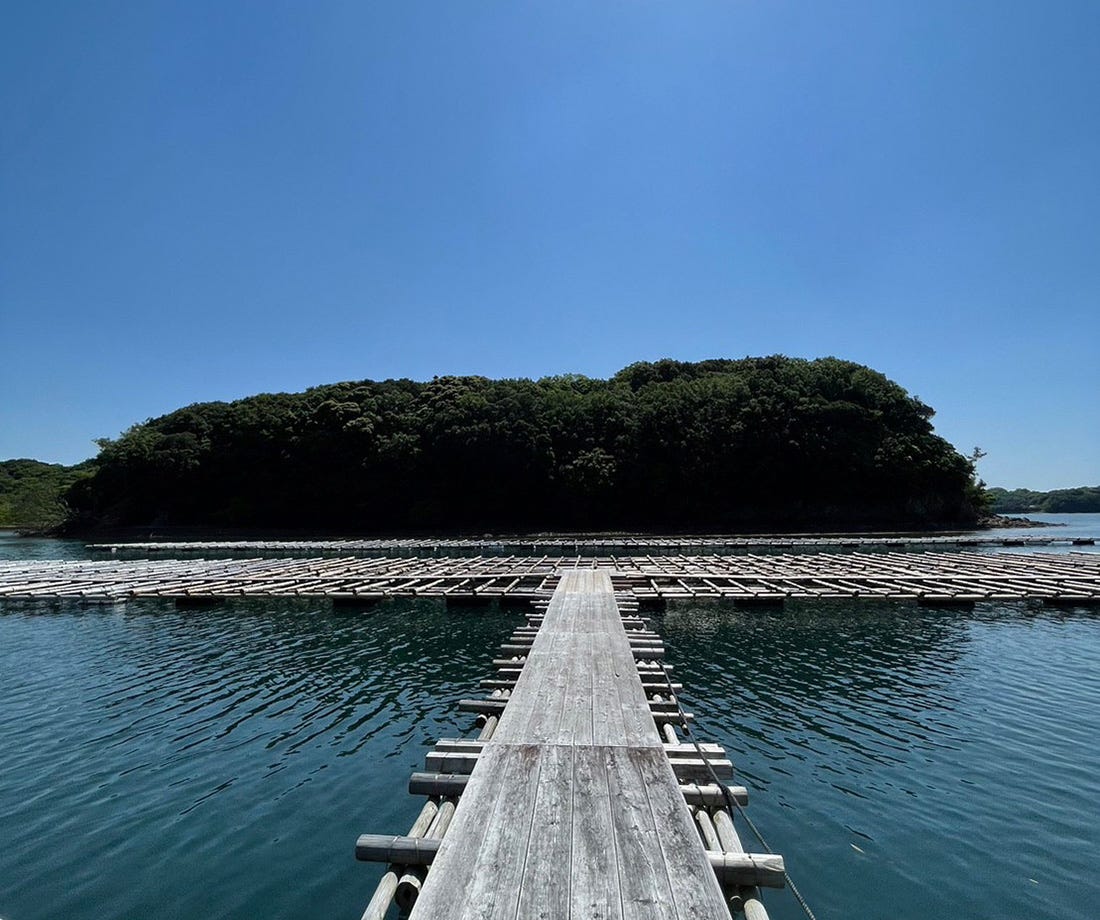
Farming rafts stretch across the sea surface, swaying softly with the small waves, and a wooden, single-story building reminiscent of an old elementary school stands by the water. Extending far beyond the inlet, Ago Bay glitters in the morning sun, its islands gently layered atop one another as they rest.
Against this tranquil, picturesque backdrop, a woman greeted us warmly.
“Welcome to Tatoku. It’s wonderful to meet you all.”
Ms. Yaegashi, Mikimoto’s PR General Manager, beamed as she shook our hands and greeted us in English. Her cropped hair was beautifully complemented by pearl earrings. She readily agreed to our request for a tour and interviews with both the Tatoku Pearl Farm and the Toba Factory. “I’d be thrilled to help with an exhibition at the Metropolitan Museum of Art,” she said, traveling all the way from Tokyo for the occasion. She apparently majored in Western art history at university herself.
Rita held Ms. Yaegashi’s hand and said with heartfelt warmth, “I’ve been researching pearls for an exhibition, exploring how they appear in different jewellery pieces and paintings. Today is a highlight of that journey. My dream of visiting the ‘hometown’ of pearls has finally come true.”
Following Rita, I introduced myself. Aomi then shook Ms. Yaegashi’s hand with the same firm confidence she had shown in her US trading career, saying, “I’m Aomi, an ama diver.”
When Ms. Yaegashi learned that the two visitors from New York and the local ama diver were friends, she was not just surprised, but genuinely impressed. “That’s amazing. It feels like this place and Manhattan are suddenly connected,” she said excitedly.
Next, we were introduced to Mr. Yamauchi, Manager of the Pearl Farm. Since his position has been held by his family for two generations, he has inherited complete expertise in cultured pearls. There is no one better than him to show us around this place.
What looked like an old-fashioned elementary school turned out to be the workshop. I couldn’t hide my amazement, having pictured it as a sterile, lab-like space. It’s a heartwarming surprise that the starting point of elegant jewellery captivating people worldwide lies within this nostalgic wooden building.
“Is this where Miss Misaki Takemoto works?”
Misaki, the young artisan we met at last night’s get-together left early without hesitation, saying, “I need to get going because of work tomorrow.” She said she is in charge of “nucleation” at the farm. I wanted to ask in advance what that work entails, but her mother, Nagisa, insisted I wait until the tour, saying that nothing beats seeing it for yourself. So I have come looking forward to it.
“Yes, Miss Takemoto is hard at work right now. Let’s go look,” Mr. Yamauchi said, and we followed along.

When we stepped inside the wooden building, a remarkably wondrous sight awaited us.
Worktables are neatly arranged like classroom desks, with sea-facing glass windows to their right. At each table, artisans work wordlessly, completely absorbed in their tasks. From time to time, a light sea breeze drifts in through the wide-open windows, bringing refreshing air. Silence and calm pervade the room, as if it belongs in a still life painting.
Misaki was working at the table closest to the entrance door, but none of us approached her. We didn’t want to get in the way of her work. Instead, Mr. Yamauchi called out to her in a friendly tone. “Miss Takemoto, we have visitors from abroad.”
Misaki stopped her hands and lifted her face. She greeted us with a shy smile, then immediately returned to her task.
“Why not take a closer look?”
Prompted by Aomi, Rita and I stood on either side of Misaki. Noticing that we were both holding our breath, Mr. Yamauchi laughed and said, “You don’t need to be so quiet. Feel free to ask her anything.”
“But I’d feel bad interrupting her…,” I mumbled, and Misaki lifted her face once more.
“What I’m doing right now is ‘nucleation’ — the process Rita asked about yesterday. From the adjacent table, I take a small piece of mantle tissue from an Akoya oyster, called the ‘piece,’ and insert it into another Akoya oyster along with a ‘nucleus’ made from a shell bead.”
Rita and I leaned in as much as we could to carefully watch the mystical task.
An Akoya oyster is secured to a stand on the worktable. The “nucleus” is inserted into the oyster’s slightly opened shell, along with the “piece,” using a stick resembling a knitting needle. Misaki’s hands move with great dexterity, efficiently performing one nucleation after another.
Once nucleated, we learned that the oysters are returned to the bay where pearls form inside them over the course of many years.
Maha HARADA
b. 1962 Tokyo, Japan
Based between Tokyo, Paris, Kyoto, and Nagano, Maha Harada is a creative visionary and exceptional storyteller who has produced world-class, category-defying writing.
Harada is one of the founding curators of Tokyo’s acclaimed Mori Art Museum; when it was established, she was sent to represent the Museum as a project researcher at its principal cultural partner, The Museum of Modern Art, New York. It is for this reason that Maha Harada is renowned as Japan’s leading creator of art novels and art entertainment.
She is among Japan’s most talked-about writers and creatives, and her extraordinary experiences give her an unparalleled ability to blend art and literature. Harada’s art novels journey into the past to breathe fresh life into some of the world’s most beloved artists, who still enchant countless people today. These stories transcend time and generation crossing the boundaries of nation and region. At the same time, they are rooted in the experiences of a woman born and raised in Japan.

 Back to "Everything in harmony"