


 Back





Please select a location and what language you would like to see the website in.

Introducing our new article series with writer Maha Harada. Dive deeper into the world of pearls through her essays and stories exclusive to Mikimoto.
Vol.9
Gifts from the sea
Pearls, prized as organic gems, carry a warm glow found nowhere else.
Rita, Aomi, and Roka — three friends from graduate school gathered in Toba.
Rita, who works at the Metropolitan Museum of Art, is paying a visit to conduct interviews for an exhibition.
Part 5
Read Part 4Watching the nucleation process was like observing a transplant surgery. I realized you need to be extremely skilled with your hands.
“I’m finally getting the hang of it,” said Misaki, who is now in her fifth year working at the farm.
“I see. So this ‘operation’ is the key to successful pearl cultivation,” Rita murmured with a soft sigh.
“It’s the work of experience and skill. Pure craftsmanship,” Aomi also commented, looking impressed even though this was her second viewing.
Pearls are essentially “gifts of chance,” formed when a fragment of the mantle — the tissue that builds the shell in Akoya oysters — enters the oyster due to some trigger. This tissue then creates a “sac” around itself, which fills with a shimmering substance called nacre. Over time, a pearl forms inside the sac.
Nucleation is the process by which pearl formation is manually initiated. However, since the pearls are nurtured in the sea and the oysters themselves voluntarily produce them, these cultured pearls are scientifically no different from natural pearls.
Having studied relevant books and online resources, Rita and I came here thinking we had a basic understanding of pearl formation. Even so, when we watched the culturing process for ourselves, it felt like witnessing something sacred.
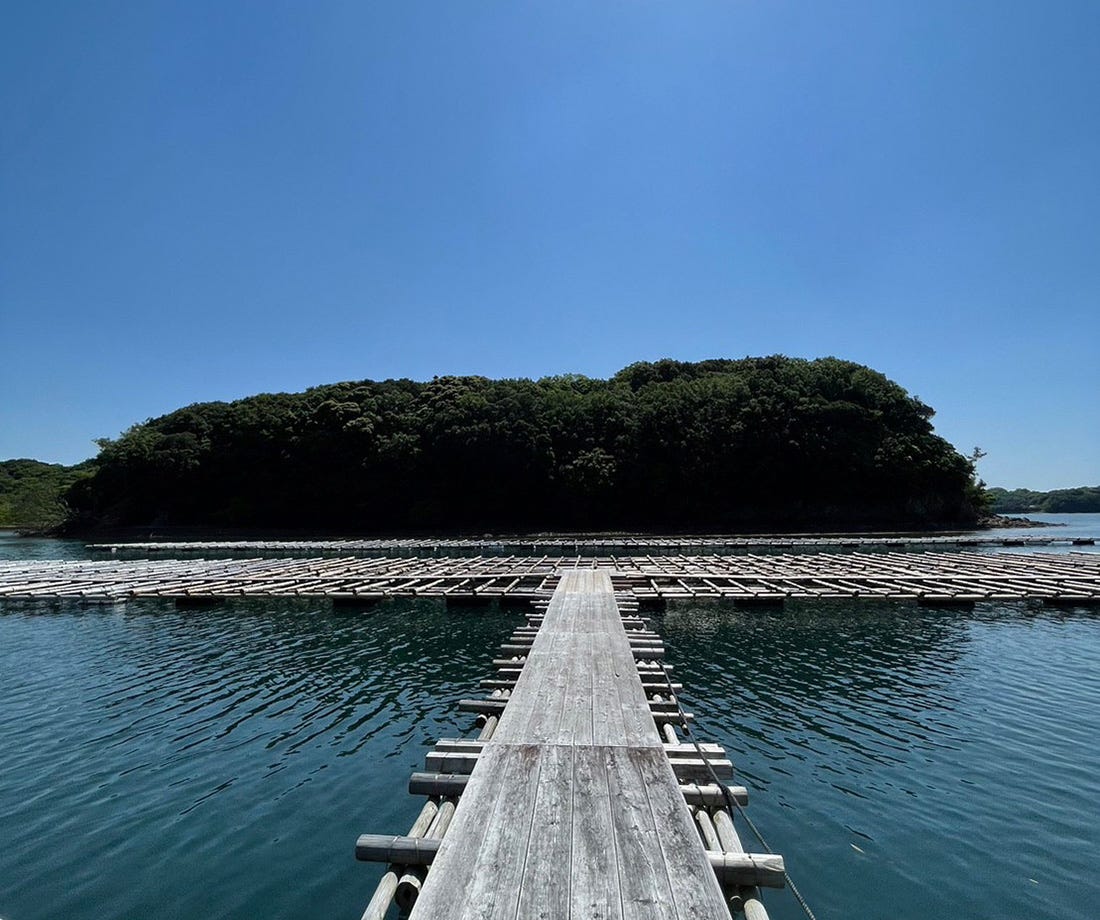
In this place, there were no computers, smartphones, or electronic devices of any kind. Against the background of the blue sea, a gentle hill, and a clear blue sky, the artisans worked quietly in a rustic, schoolhouse-style building, carefully handling each oyster one by one. It is the harmony between nature’s forces and human craftsmanship that brings those ethereal pearls into this world.
Further into the workshop, there was a water area where “mother oysters” — Akoya oysters waiting to be nucleated — were lined up in a large pale blue case and submerged in water. According to Mr. Yamauchi, the baby oysters harvested in spring are first put in culturing nets and carefully tended as they grow in the sea, a process that takes about two years.
During this time, the nets are replaced as the oysters expand and the oysters are occasionally lifted from the water to remove barnacles and other oysters that have attached to the shells. Constant attention is provided to help them develop into healthy mother oysters. After nucleating, the mother oysters are returned to the sea, and it takes another two years for the pearls to form. The entire process takes about four years in total.
“It’s like university, from freshman to graduation,” I commented.
“That’s right. You start feeling like a parent along the way,” Mr. Yamauchi replied with a chuckle.


Upon leaving the workshop, Ms. Yaegashi suggested, “Let’s go visit the house of Kokichi Mikimoto.” Behind the farm is a modest hill, and Mr. Kokichi Mikimoto’s final residence sits atop it, overlooking Ago Bay.
Not only were there residences, but the area even had a police box and a post office, both now unused. Inside the post office, to which we were granted special entry, posters from the Showa era hung as if time had stopped there for years.
“Why would a post office be here?” Rita asked.
“All our employees’ salaries were paid through this post office. They could also make phone calls and send telegrams here. I imagine it served as a kind of communications center,” Ms. Yaegashi explained.
That makes sense. Aomi and I exchanged a satisfied nod.
After climbing some stone steps shaded by green foliage, we reached the residence of the venerable Mr. Kokichi Mikimoto. This was the home of the “Pearl King,” whose name echoed across the globe. I had imagined it would be a lavish mansion, but it was surprisingly modest — simple yet tasteful. Nevertheless, the house is said to have been visited by numerous VIPs. I have no doubt that Mr. Mikimoto proudly showed each guest this breathtaking scenery of his hometown: the view of Ago Bay as far as the eye can see.
The vast sea, as seen from the hilltop, was indescribably invigorating — shimmering under the early summer sun high above the horizon. The area was filled with peaceful, clean air. Though it was my first time here, a strange feeling welled up as I watched the sea, as if retrieving the nostalgic memories that lingered in this place.
From behind me, I heard Ms. Yaegashi explaining, “Mr. Mikimoto was just so fond of pearls. He worked pearl designs into the house wherever he could. Look, you can see pearl-like round shapes in the windowpanes and roof tiles.”
“Wow, it’s true!” Rita and Aomi exclaimed. I turned around, and at that precise moment, my eyes met those of an elderly gentleman standing behind Ms. Yaegashi.
Wearing a kimono and a fedora, he watches me silently.
I instinctively bowed my head. Then, with a slight lift of his hat, he returned my smile. I stepped closer to Ms. Yaegashi and asked in a low voice, “Is there another guest here today?”
Ms. Yaegashi looked at me, puzzled.
“Over there…,” I said, as I glanced over to where the elderly gentleman stood, but no one was there anymore.
Maha HARADA
b. 1962 Tokyo, Japan
Based between Tokyo, Paris, Kyoto, and Nagano, Maha Harada is a creative visionary and exceptional storyteller who has produced world-class, category-defying writing.
Harada is one of the founding curators of Tokyo’s acclaimed Mori Art Museum; when it was established, she was sent to represent the Museum as a project researcher at its principal cultural partner, The Museum of Modern Art, New York. It is for this reason that Maha Harada is renowned as Japan’s leading creator of art novels and art entertainment.
She is among Japan’s most talked-about writers and creatives, and her extraordinary experiences give her an unparalleled ability to blend art and literature. Harada’s art novels journey into the past to breathe fresh life into some of the world’s most beloved artists, who still enchant countless people today. These stories transcend time and generation crossing the boundaries of nation and region. At the same time, they are rooted in the experiences of a woman born and raised in Japan.

 Back to "Everything in harmony"